
Brand: Mercedes-Benz
Country of Origin: Germany 🇩🇪
Brand Established: 1926
Automotive Heritage: Since 1886
Industry: Luxury Automotive, Mobility & Technology
Headquarters: Stuttgart, Germany
Company: Mercedes-Benz Group AG
Official Website: Mercedes-Benz Official Website
Featured By: ASIA Best Brands — Global Brands
About Mercedes-Benz
Mercedes-Benz is one of the world’s most established luxury automotive brands, recognised for combining engineering, safety, performance, comfort and premium design.
Its heritage reaches back to 1886, when Carl Benz patented the Benz Patent-Motorwagen while Gottlieb Daimler was independently developing early motorised vehicles. The Mercedes-Benz brand itself emerged in 1926, following the merger of Benz & Cie. and Daimler-Motoren-Gesellschaft.
Today, Mercedes-Benz operates across luxury passenger cars, performance vehicles, premium vans, electric mobility and increasingly software-defined vehicles.
From the Invention of the Automobile to a Global Luxury Brand
Few automotive brands have a history as closely connected to the development of the automobile as Mercedes-Benz.
Following the 1926 merger, the new Mercedes-Benz identity combined Daimler’s three-pointed star with the heritage of Benz. The emblem subsequently became one of the most recognisable symbols in the automotive industry.
Over the decades, models including the S-Class, E-Class, G-Class, SL and Mercedes-AMG performance vehicles helped establish the brand across luxury, executive and high-performance segments.
This heritage remains central to Mercedes-Benz, but the company continues to redefine what a premium automobile can offer.
Luxury Through Technology

Mercedes-Benz MB.OS System. Image Source: Car Magazine.
Mercedes-Benz has long competed through engineering innovation rather than luxury alone.
Modern vehicles combine advanced driver assistance, digital displays, connected services and intelligent vehicle systems with the traditional qualities of comfort, craftsmanship and performance.
A major step in this transformation is MB.OS — the Mercedes-Benz Operating System.
Introduced in production vehicles in 2025 with the new CLA, MB.OS connects four major areas: infotainment, automated driving, body and comfort, and driving and charging. It is designed as a continuously updateable digital foundation for future Mercedes-Benz vehicles.
Entering the Software and AI Era
Mercedes-Benz increasingly views software and artificial intelligence as core parts of the driving experience.
The new CLA introduced an AI-powered generation of the MBUX Virtual Assistant, while MB.OS allows Mercedes-Benz to integrate digital services and technologies from partners while retaining control over the vehicle’s core architecture.
The company is also working with technology companies including Google and Microsoft on areas such as AI-powered navigation, productivity and connected vehicle experiences.
This shift reflects a broader transformation in the automotive industry, where software is becoming as important to the customer experience as mechanical engineering.
Electrification and the Next Generation of Mercedes-Benz
Electric mobility is another major part of Mercedes-Benz’s transformation.
The company continues to develop both electric and electrified combustion vehicles, adjusting its product strategy according to customer demand, infrastructure and market conditions.
Its next-generation platforms incorporate more efficient electric drivetrains, advanced battery technologies and technologies developed through projects such as the highly efficient VISION EQXX.
Mercedes-Benz is targeting electrified vehicles to represent more than 30% of its sales by 2027, supported by an expanding range of battery-electric and plug-in hybrid models.
A Significant Brand Across Asia
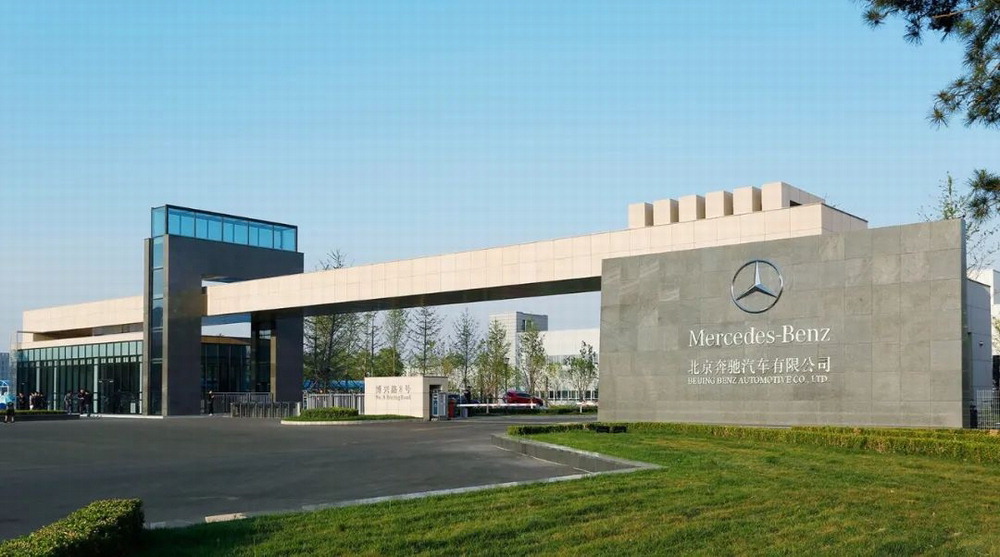
Mercedes-Benz China production plant BBAC, which opened in 2005 south of Beijing, China. Image Source: MAEIL BUSINESS
Asia remains one of Mercedes-Benz’s most important regions.
In 2025, Mercedes-Benz Cars sold approximately 747,000 vehicles across Asia, including about 551,900 in China. China also hosts Mercedes-Benz’s largest research and development centre outside Germany.
The company has expanded local development in Beijing and Shanghai and works with Chinese technology partners to create market-specific navigation, infotainment and assisted-driving features.
Its wider Asian technology network also includes development locations in Japan, South Korea and India, showing the region’s importance not only as a market but also as a source of automotive and software innovation.
Global Scale and Brand Strength
Mercedes-Benz remains one of the world’s largest premium automotive businesses.
In 2025, Mercedes-Benz sold approximately 2.2 million cars and vans worldwide, including around 1.8 million passenger cars.
Mercedes-Benz Group recorded €132.2 billion in revenue for the same year.
Beyond volume, the company continues to emphasise its premium and top-end portfolio, including Mercedes-AMG, Mercedes-Maybach, the G-Class and S-Class.
A Century-Old Brand Preparing for a New Era
In 2026, Mercedes-Benz marks 100 years of the Mercedes-Benz brand and 140 years since the beginnings of the automobile associated with Carl Benz and Gottlieb Daimler.
That history gives the brand an unusual position: it is deeply connected to the origins of motoring while simultaneously investing in electric vehicles, artificial intelligence, automated driving and software-defined cars.
The challenge for Mercedes-Benz is therefore not simply preserving its heritage, but translating the meaning of luxury into a new technological era.
Why Mercedes-Benz Is Featured on ASIA Best Brands
Mercedes-Benz demonstrates how a century-old brand can preserve a strong identity while continuously adapting to technological change.
From pioneering early automobiles to developing premium vehicles, electric drivetrains, AI-powered interfaces and its own automotive operating system, the brand has repeatedly evolved alongside the mobility industry.
Its significant presence across China, Japan, South Korea, India and Southeast Asia, together with its growing Asian research and technology network, also makes the region an important part of its future.
By combining heritage, engineering, luxury and technological innovation, Mercedes-Benz remains one of the most influential automotive brands featured on ASIA Best Brands.
Official Website:
Mercedes-Benz Official Website
Category: Luxury Automotive | Mobility | Technology
Tags: Mercedes-Benz, Luxury Cars, German Automotive Brands, Mercedes-AMG, Mercedes-Maybach, Electric Vehicles, MB.OS, Automotive Technology, Global Brands, ASIA Best Brands
Sources
1. Mercedes-Benz — Official Website
Official consumer website covering Mercedes-Benz vehicles, technology and the brand.
Visit Mercedes-Benz
2. Mercedes-Benz Group — Brand History
Official history covering the creation of Mercedes-Benz and the evolution of the brand.
Mercedes-Benz Brand History
3. Mercedes-Benz — 100 Years of the Brand
Official information covering the 1926 formation of Daimler-Benz and the origins of Mercedes-Benz.
100 Years of Mercedes-Benz
4. Mercedes-Benz — 2025 Vehicle Sales
Official figures covering Mercedes-Benz Cars and Vans sales worldwide and across major regions.
Mercedes-Benz 2025 Sales
5. Mercedes-Benz Group — 2025 Annual Results
Official financial information covering revenue, performance and future product strategy.
Mercedes-Benz 2025 Results
6. Mercedes-Benz — MB.OS
Official information on the Mercedes-Benz Operating System and its role in future vehicles.
Mercedes-Benz Operating System
7. Mercedes-Benz — The New CLA
Official information covering the new CLA, electric technology, MB.OS and AI-powered MBUX.
Mercedes-Benz CLA Technology
8. Mercedes-Benz — China and Asia Technology Development
Official information on China-specific vehicles, local R&D and Mercedes-Benz’s largest R&D hub outside Germany.
Mercedes-Benz at Auto Shanghai 2025